
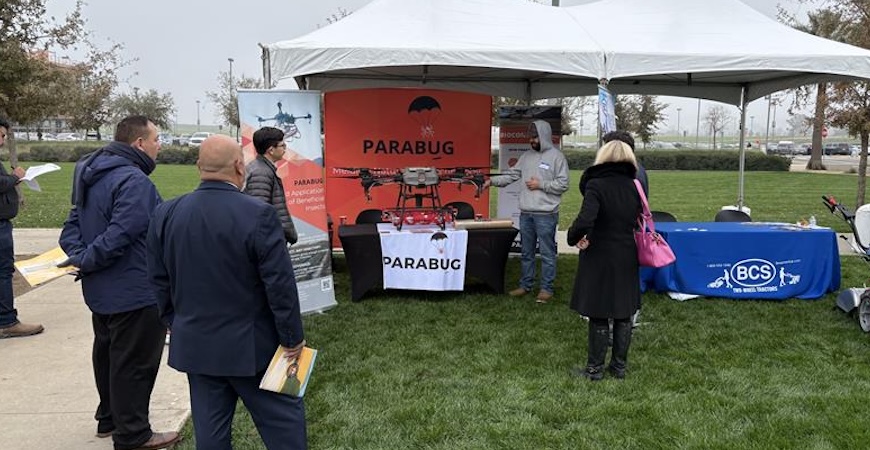
The Small Farm Tech Expo brought researchers, farmers, university students and even a group from a Modesto elementary school to UC Merced to talk about agriculture technology and how it can best help those who grow the world's food.
Sponsored by the Community Alliance with Family Farmers, also known as CAFF, for the fifth year, the expo featured equipment demonstrations, educational sessions on hardware and software, panel discussions, and support organizations to highlight what's available for small farmers.
"We all eat in the San Joaquin Valley," said Leigh Bernacchi, executive director of the Valley Institute for Sustainability, Technology and Agriculture at UC Merced. "Today we are also learners."
While many of the advances in agricultural technology are available for larger farmers, those who run smaller operations often don't have access to them.
"The small farmer does everything," Bernacchi said. "They prep, plant, nourish, care, protect, harvest, restore land, package, sell, haul and price. They need help and we need to all contribute to support small farmers."
To do that, CAFF advertised its? small farms innovation challenge designed to enable all innovators to be compensated for their agtech solutions. Additionally, CAFF released at the eventa report on small farm technology needs to guide innovators.
Presentations included sessions on agrivoltaics, a farmer discussion of challenges ahead, and an introduction to the lending library offered through University of California Agriculture and Natural Resources and F3 Local, based at the ag research and extension center in Parlier.
Amber Butland, lending library coordinator, said the library is available for people who farm under 50 acres in Fresno, Tulare, Kings, Madera, or Merced counties. The program could be expanded to other areas in the future.
Items such as compost spreaders, tractors, seeders and weeders can be borrowed for one to four days after the operator completes training on the equipment. There will be a fee ranging from $20 to $60 once the fee collection infrastructure is in place, Butland said.
"This is a little bit of an experiment to see what works and what doesn't," Butland said.
The library even offers a Gather robot, designed to transport crops. The operator just pushes a button and "it's going to follow you wherever you go," Butland said.
At another workshop, farmers were invited to share challenges they have with their operations. These included laying down plastic and cutting holes in it for strawberry plants, picking citrus from hillside orchards, and harvesting lavender.
"We want to learn from everybody what are your thoughts and ideas," said Marissa Johnson, agricultural outreach specialist with UCANR.
The issues raised at the workshop will inform the next meeting of SF-ADAPT, a program through Farms Food Future Local that connects small-scale farmers with researchers, nonprofits and technologists to create tools that work on smaller farms.
"We are looking at technology that is simple, effective and easy to implement," Johnson said, "and that farmers can build and repair themselves."
UC Merced, located in the heart of the Central Valley, is uniquely positioned to help farmers address their challenges, Bernacchi said.
She said she envisions a future where farmers have the tools they need, researchers find cost-effective ways to pull carbon and from the atmosphere and return it to the soil and where workers can find a career path that supports their families.
"I see bots roam and enable sustainable practices, and UC Merced students act like the Geek Squad to come and repair equipment, where no child is hungry, where every child is full of nutritious food grown by farmers, real people," Bernacchi said. "Continue to work with us as we build the future of agriculture."


